
How BYD Beat Tesla: From Battery Maker to EV Leader
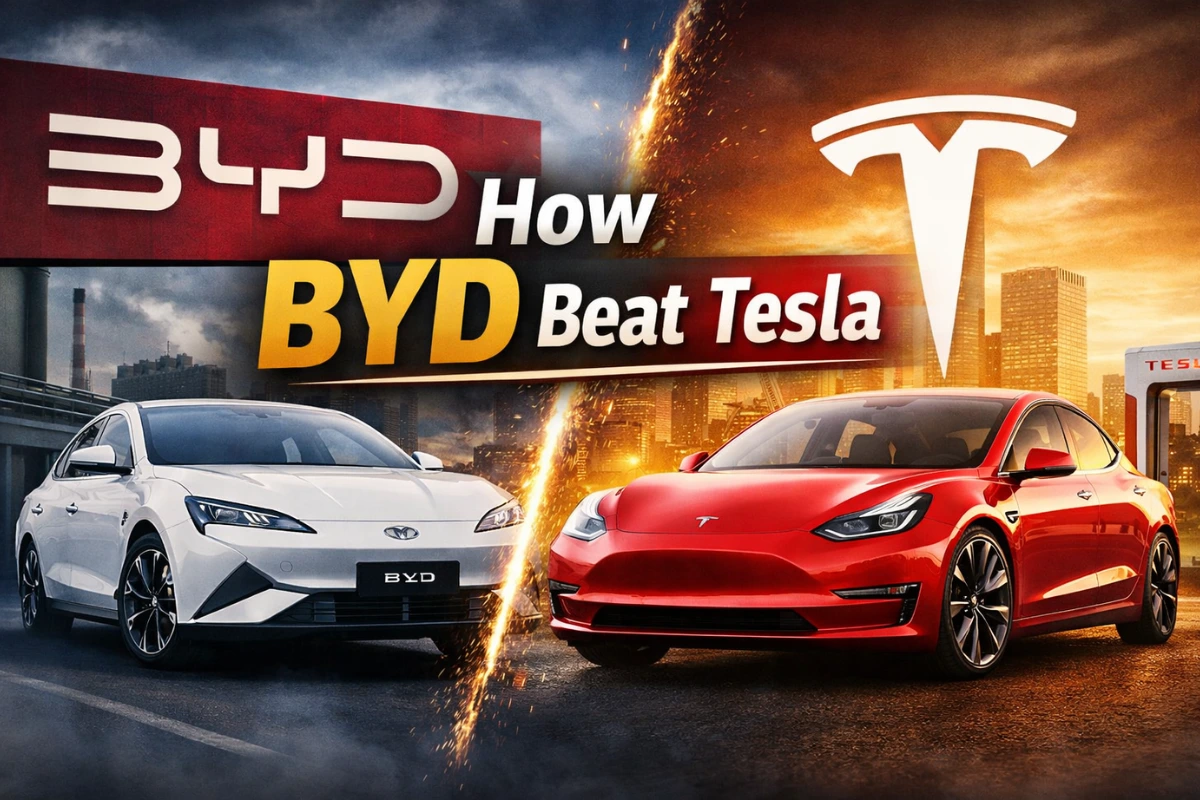
For many years, Tesla was seen as the undisputed leader of the electric vehicle world. It made EVs popular, desirable, and global. But over time, another company quietly grew stronger and eventually overtook Tesla in important ways. That company is BYD, a Chinese electric vehicle and battery manufacturer.
BYD did not beat Tesla overnight. It happened slowly, through smart decisions, local understanding, and strong control over costs and technology. This story is not about one company failing but about how a different approach led to success.
Understanding BYD and Tesla’s Different Origins
Tesla started as a tech-driven car company with a strong focus on innovation, design, and branding. Its mission was to accelerate the world’s transition to sustainable energy. Tesla focused heavily on premium electric cars first and later expanded to mass-market models.
BYD, on the other hand, began as a battery company. Long before making cars, BYD was already building batteries for phones and electronics. This background gave BYD deep experience in battery technology, which later became its biggest advantage in electric vehicles.
From the start, both companies had very different foundations, which shaped how they grew.
Battery Control Was BYD’s Biggest Strength
One of the most important reasons BYD beat Tesla is batteries. BYD makes its own batteries, especially its well-known Blade Battery. This gives BYD strong control over costs, supply, and safety.
Tesla relies on battery suppliers like Panasonic, CATL, and LG, even though it works closely with them. This means Tesla is still affected by global supply chain issues and pricing changes.
BYD’s vertical integration allows it to reduce costs, improve safety, and scale production faster. In the EV world, battery cost is everything, and BYD mastered it early.
Affordable Cars for the Mass Market
Tesla focused heavily on premium and mid-range vehicles. While models like the Model 3 and Model Y became popular, Tesla struggled to deliver truly low-cost EVs at scale.
BYD took a different path. It focused on affordable electric and plug-in hybrid cars for everyday users. In markets like China, price matters more than branding. BYD offered EVs that were cheaper, practical, and reliable.
This strategy allowed BYD to sell in much higher volumes, especially in its home market.
Strong Presence in China
China is the largest electric vehicle market in the world. BYD understood the local market better than any foreign brand. It worked closely with local governments, suppliers, and charging infrastructure providers.
Tesla entered China later and faced strong competition from many local brands. While Tesla still performs well in China, it does not dominate the market the way it once did.
BYD’s deep local roots gave it an edge in distribution, pricing, and customer trust.
Plug-in Hybrids Helped BYD Scale Faster
Another smart move by BYD was its strong focus on plug-in hybrid vehicles. These cars combine electric driving with traditional engines, making them more practical in areas with limited charging infrastructure.
Tesla makes only fully electric vehicles. While this aligns with its long-term vision, it limits flexibility in markets where EV infrastructure is still developing.
BYD’s hybrid strategy helped it reach more customers and grow faster, especially in emerging markets.
Better Cost Control and Profit Stability
BYD is known for its tight cost control. Because it manufactures many key components in-house, it is less affected by external price shocks.
Tesla has strong margins but is more exposed to price wars. In recent years, Tesla reduced prices multiple times to maintain sales volume, which hurt profitability.
BYD managed to balance pricing and margins better by keeping production costs low.
Wider Product Range
BYD offers a wide range of vehicles, from small city cars to sedans, SUVs, buses, and even trucks. This diversification spreads risk and increases total sales volume.
Tesla’s lineup is much smaller. While Tesla cars are globally recognized, the limited range restricts growth in certain segments.
BYD’s ability to serve many customer types helped it scale faster.
NFL Christmas Gameday: Latest News and What Fans Need to Know
Global Expansion Strategy
BYD expanded globally in a careful and strategic way. It entered markets in Southeast Asia, Latin America, Europe, and parts of Africa with locally adapted products.
Tesla expanded globally too, but its pricing and product strategy did not always match local purchasing power. BYD often undercuts competitors on price while meeting local regulations.
This made BYD more competitive in developing markets.
Government Policies and Timing
Government policies played a role as well. China heavily supported electric vehicles through subsidies, infrastructure investment, and industrial planning.
BYD benefited greatly from this environment, but it also executed well. Many other Chinese EV companies failed despite the same support.
Tesla also benefited from incentives in different countries, but BYD’s alignment with China’s long-term EV strategy gave it extra momentum.
Did BYD Really “Beat” Tesla?
The answer depends on how you measure success. BYD overtook Tesla in total EV and plug-in hybrid sales globally. It also became one of the world’s largest EV manufacturers by volume.
Tesla still leads in certain areas, such as brand recognition, software, charging network, and profitability per vehicle. Tesla remains a very strong company.
But in terms of scale, affordability, and market coverage, BYD clearly pulled ahead.
Final Thoughts
BYD beat Tesla not by copying it, but by choosing a different path. BYD focused on batteries, cost control, affordable cars, and local market understanding. Tesla focused on innovation, branding, and a fully electric vision.
Both approaches have strengths. Tesla changed the world’s view of electric cars. BYD made electric mobility accessible to millions.